
Quitman County Court Records After Arrest
The local path is arrest, booking, Magistrate Court warrant or early matter, prosecutor filing, then Clerk of Superior Court record keeping. Quitman County research did not locate an official free criminal case-search portal with a defendant-name or case-number field inventory. That changes the best search method. The most reliable route is to confirm the jail booking with the Sheriff, ask Magistrate Court about warrant or first-stage matters, then contact the Clerk of Superior Court for filed misdemeanor and felony records.
The jail side and the court side answer different questions. The jail record may show that a person was booked, held, bonded, released, or transferred. The court record after the arrest shows what was filed and what happened next. For custody and booking status, use the Quitman County jail inmate records workflow. For booking photos, use the Quitman County jail mugshots workflow. Court records after a jail arrest should be checked with the court offices that keep warrants, accusations, indictments, case files, and dispositions.
The county and circuit sources identify the key offices. Rebecca S. Fendley is the Clerk of Superior Court, with a published office phone of 229-334-2578 and a mailing address of P.O. Box 307, 111 Main Street, Suite 2, Georgetown, GA 39854. Magistrate Judge L. Matthew Self is listed for Magistrate Court, phone 229-334-2224, P.O. Box 7, Georgetown, GA 39854. The Pataula Judicial Circuit District Attorney is Ronald (Vic) McNease Jr., at 12850 Magnolia Street, Blakely, GA 39823, phone 229-724-3011.
Find Quitman County Arrest Court Records
Because no official free Quitman County criminal case portal was located, a court records after arrest search works best as a contact workflow. Start with the most recent fact, then move to the office that owns the next record. A jail booking charge is not proof that the prosecutor filed the same charge. A warrant may start in Magistrate Court, while a later accusation or indictment is maintained with filed Superior Court records.
- Confirm the booking or custody fact with the Quitman County Sheriff's Office if the arrest is recent. Ask for the booking charge, bond status, release status, and whether the person was transferred.
- Call Magistrate Court at 229-334-2224 when the issue is a warrant, early warrant paperwork, or lower-court bond and first-stage case action.
- Contact Clerk Rebecca S. Fendley at 229-334-2578 for filed misdemeanor or felony records, warrants, accusations, indictments, jury records, and case-file access.
- Contact the Pataula Judicial Circuit District Attorney at 229-724-3011 for prosecutor-filed charges, victim services, and prosecution-office questions.
- When making a written request, include the person's full name, approximate arrest or booking date, charge if known, case number if known, and the exact records sought.
Do not leave case-specific facts in a public website comment form. The District Attorney page warns users not to place case details in comments and directs people to contact the DA or Public Defender directly. That caution is useful in Quitman County court records after arrest work because names, dates, witness facts, and victim-service issues should be handled through the correct office, not a public form.
Quitman County Court Request Contacts
The first court contact depends on the stage of the arrest case. Magistrate Court is tied to warrants and early lower-court action. The Clerk of Superior Court keeps filed criminal records, including misdemeanor and felony records, warrants, accusations, and indictments. The District Attorney files or manages prosecution decisions after arrest, including accusations, indictments, reductions, dismissals, pleas, and trial dispositions.
Clerk of Superior Court
Rebecca S. Fendley
P.O. Box 307
111 Main Street, Suite 2
Georgetown, GA 39854
229-334-2578
Magistrate Court
Judge L. Matthew Self
P.O. Box 7
Georgetown, GA 39854
229-334-2224
Pataula Circuit DA
Ronald (Vic) McNease Jr.
12850 Magnolia Street
Blakely, GA 39823
229-724-3011
The Quitman County Probate and Magistrate Court page is a subject match for warrant and early-court details in this arrest-to-court path.
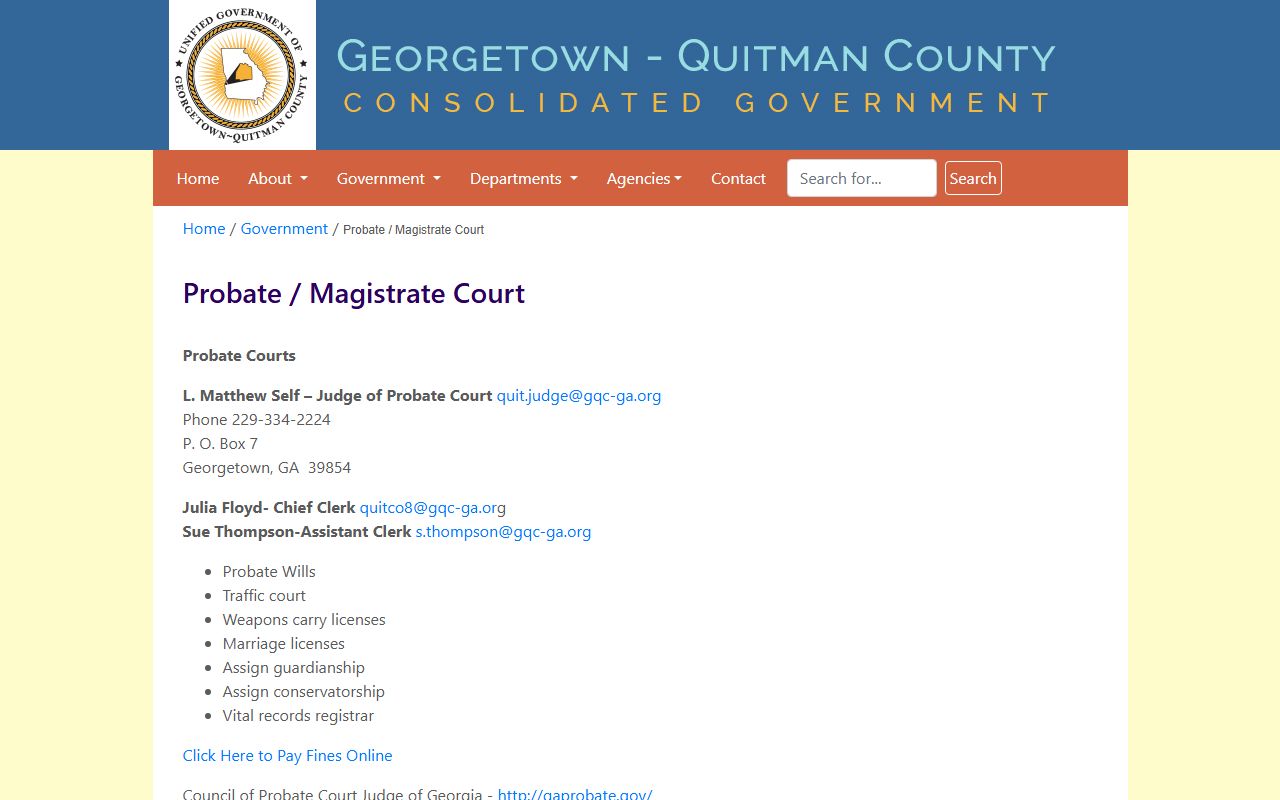
The screenshot reinforces that Magistrate Court is part of the local warrant workflow, while filed criminal case records should still be requested through the Clerk of Superior Court.
Quitman County Arrest Charging Records
Formal charges may differ from the charge typed into the booking record at intake. The arresting agency may book a person under one suspected offense, while the prosecutor may file a different charge, add counts, reduce a count, or decline to go forward. In Quitman County, the Clerk of Superior Court page identifies accusations and indictments as filed records, and the District Attorney is the prosecution office for the Pataula Judicial Circuit.
| Document | Who Is Involved | What It Means After Arrest |
|---|---|---|
| Complaint or warrant paperwork | Law enforcement, Magistrate Court, or prosecutor | Early paperwork that can support arrest, warrant action, bond review, or the first court step. |
| Accusation | District Attorney | A formal prosecutor-filed charging document, often used to move a criminal case forward without a grand-jury indictment. |
| Indictment | Grand jury and District Attorney | A grand-jury charging document used in more serious criminal matters and maintained with filed court records. |
When asking for Quitman County court records after a jail arrest, name the document type if possible. If the document type is unknown, ask the clerk whether any warrant, accusation, indictment, disposition, or sentencing record exists for the person and arrest date. That phrasing gives the clerk a narrow records target without assuming the case reached a later stage.
Quitman County Charge Status
Charge status is the part of the court record that often matters most after a jail arrest. A booking entry may say one thing on day one, but the court file can later show that a charge is pending, amended, reduced, dismissed, nolle prossed, or resolved by plea or verdict. Each term should be read as a case-stage label, not as a broad judgment about the person.
| Status | Plain Meaning | Where to Confirm |
|---|---|---|
| Pending | The charge or case has not reached final disposition. | Clerk of Superior Court or active court file. |
| Accusation filed | The prosecutor filed a formal charging document. | Clerk record and District Attorney office. |
| Indicted | A grand jury returned a charging document. | Clerk record for the indictment and case docket. |
| Amended or reduced | The filed charge changed after the first filing. | Clerk record, DA office, or court order. |
| Dismissed or nolle prossed | The charge ended without a conviction on that count. | Disposition entry or order in the court file. |
| Conviction | A guilty plea, verdict, or adjudication created a final finding. | Disposition, sentence, and clerk-maintained judgment records. |
Georgia records can also separate custody status from court status. A person can bond out while a charge stays pending. A person can remain held because of a no-bond order, probation or parole hold, another county warrant, federal hold, or immigration detainer even if one local charge changes. Confirm both the jail status and the court status before treating a record as complete.
Quitman County Arrest Bond Records
No Quitman County online bond-payment page or jail cashier page was located. The local bond path therefore starts by calling the Sheriff's Office at 229-334-3726 or 229-334-3739, then asking which court or judge set the bond. Georgia bond types may include cash bond, surety bond through a Georgia-authorized bonding company, property bond, or recognizance release. A recognizance release means the judge releases the person based on a promise to appear, sometimes with conditions.
Warrants also shape court records after a jail arrest. The sheriff employment page confirms deputies serve warrants and transport prisoners, and the Magistrate Court page says the magistrate approves and signs all warrants. No searchable Quitman County active-warrant database was located, although the Sheriff's Office has an official Most Wanted page with no current named entries visible in the inspected text. For warrant records, use the Sheriff for service or custody questions, Magistrate Court for warrant approval questions, and the Clerk of Superior Court for filed warrant records.
Important: The sheriff homepage warns that the office will never call to demand payment by phone.
Charges Versus Convictions
A charge is an accusation in the court process. A conviction is a final result after a guilty plea, verdict, or other adjudication. That distinction matters for Quitman County court records after an arrest because a person may have been booked, charged, and released without ever being convicted. A dismissed or nolle prossed count should not be described as a conviction.
| Issue | Charge | Conviction |
|---|---|---|
| Stage | Filed accusation, indictment, warrant, or complaint-based allegation. | Final court finding, plea, verdict, or adjudication. |
| Proof level | Based on charging decisions and probable cause or grand-jury action. | Based on a plea or proof beyond a reasonable doubt. |
| Record meaning | Shows what the state alleged after arrest. | Shows what the court finally resolved against the defendant. |
| How to verify | Ask for the filed charging document and current charge status. | Ask for the disposition, sentence, or judgment record. |
Sealed and Expunged Arrest Records
Georgia often uses the term record restriction for public access limits. People also use sealed or expunged in everyday speech, but the legal result depends on the record type, the court order, and the agency holding the record. A dismissed case, qualifying disposition, juvenile matter, protected personal data, open investigation, or exempt law-enforcement record may be limited under Georgia law. O.C.G.A. § 50-18-72 allows exemptions and redactions, while the Georgia Open Records Act keeps many public records open unless an exemption applies.
| Issue | Sealed or Restricted | Expunged |
|---|---|---|
| Public access | Public access is limited or blocked for eligible records. | The record may be removed or treated as unavailable under the controlling order. |
| Agency access | Courts, prosecutors, or law enforcement may retain limited access. | Access depends on the statute, order, and agency record system. |
| Georgia wording | Often described as record restriction in Georgia practice. | Common public term, but the exact legal effect must be checked in the order. |
| Best proof | Court order, clerk disposition, or agency response. | Court order and agency confirmation that the record was handled. |
Booking photos have an extra Georgia rule set. The Attorney General consumer page on mugshot websites cites O.C.G.A. § 10-1-393.5, which requires covered mugshot websites to remove eligible mugshots after a written request and bars removal fees. That rule is about covered mugshot websites. It is not the same thing as clearing a court charge or changing the clerk's case record.
State and Federal Record Limits
After conviction and sentencing, a Quitman County case can move beyond the county jail. O.C.G.A. § 42-5-50 requires sentencing documents to be transmitted to the Georgia Department of Corrections when a person is sentenced to state custody. GDC explains that an offender may spend up to about 30 days in a local jail waiting for diagnostic transfer, then move through diagnostic, assigned-facility, reentry, and release phases. Once that transfer occurs, the GDC offender query is the state-prison locator, not the Quitman County court docket.
Federal and immigration custody are separate. The BOP Inmate Locator covers federal inmates from 1982 to the present, but a federal pretrial detainee may not appear the same way a sentenced federal inmate appears. ICE's locator is used for immigration detention and cannot search people under age 18. No state prison, BOP facility, or ICE detention facility was located inside Quitman County, so local arrest records, state prison records, federal custody records, and immigration detention records should not be blended into one search.
Quitman County Public Access Rules
Georgia law supports public access, but it does not make every arrest detail public in every form. O.C.G.A. § 42-4-7 requires the sheriff to keep a jail record for each person committed, including identifying details, charge, commitment date, discharge date, discharge order, process or court, and issuing court. O.C.G.A. § 50-18-70 et seq. provides the state open-records framework for agency records. O.C.G.A. § 50-18-72 allows exemptions for some law-enforcement, prosecution, privacy, medical, juvenile, and confidential records.
A narrow request works best. Ask for a named record, office, date range, and person. For example, ask the clerk for filed accusations, indictments, warrants, docket entries, dispositions, or sentencing orders tied to the arrest date. Ask the Sheriff's Office for the jail booking record. Ask Magistrate Court for warrant or early-court information. Ask the District Attorney about prosecutor-filed charges or victim-service routing. That split keeps court records after a Quitman County jail arrest tied to the agency that actually keeps each record.